

FIELD NOTES: The Town That Refused to Stay Lost

The archives were uneasy today.
Not the usual fussy rustling of papers or the occasional dramatic sigh from a map that believes it deserves more attention — but a deeper, older unease. Shelves leaned inward. Lanterns flickered in patterns that felt like warnings. Even the floorboards hummed, as though remembering footsteps they had not felt in centuries.
Something was returning.
A narrow hallway unfolded between two genealogical stacks — a hallway that absolutely had not existed yesterday, or last season, or possibly ever. The air smelled of pine smoke, riverwater, and apples left too long on a windowsill.
I froze.
I knew that scent.
I had smelled it once before, during one of my… disappearances. The kind where time borrows me for an errand and forgets to return me promptly. The kind where I end up somewhere that behaves like a half‑finished thought.
A village with no name. A place where festivals happened whenever someone remembered they were supposed to. Where seasons shuffled themselves like cards. Where clocks chimed only when it felt dramatic.
The hallway widened into a clearing — an impossible clearing, because the archives do not contain forests. Yet here it was: a ring of trees, a ripple of grass, and at its center, a single object resting on a stump.
A ledger.
Bound in leather the color of twilight. Its clasp shaped like a hawthorn leaf.
My family’s crest.
The ledger pulsed once, as if recognizing me.
“All right,” I whispered. “Show me.”
The clasp unlatched.
And the world shifted.
1. The Town That Lost Its Name (Year Unknown)
The ledger opened to a page that refused to name its year.
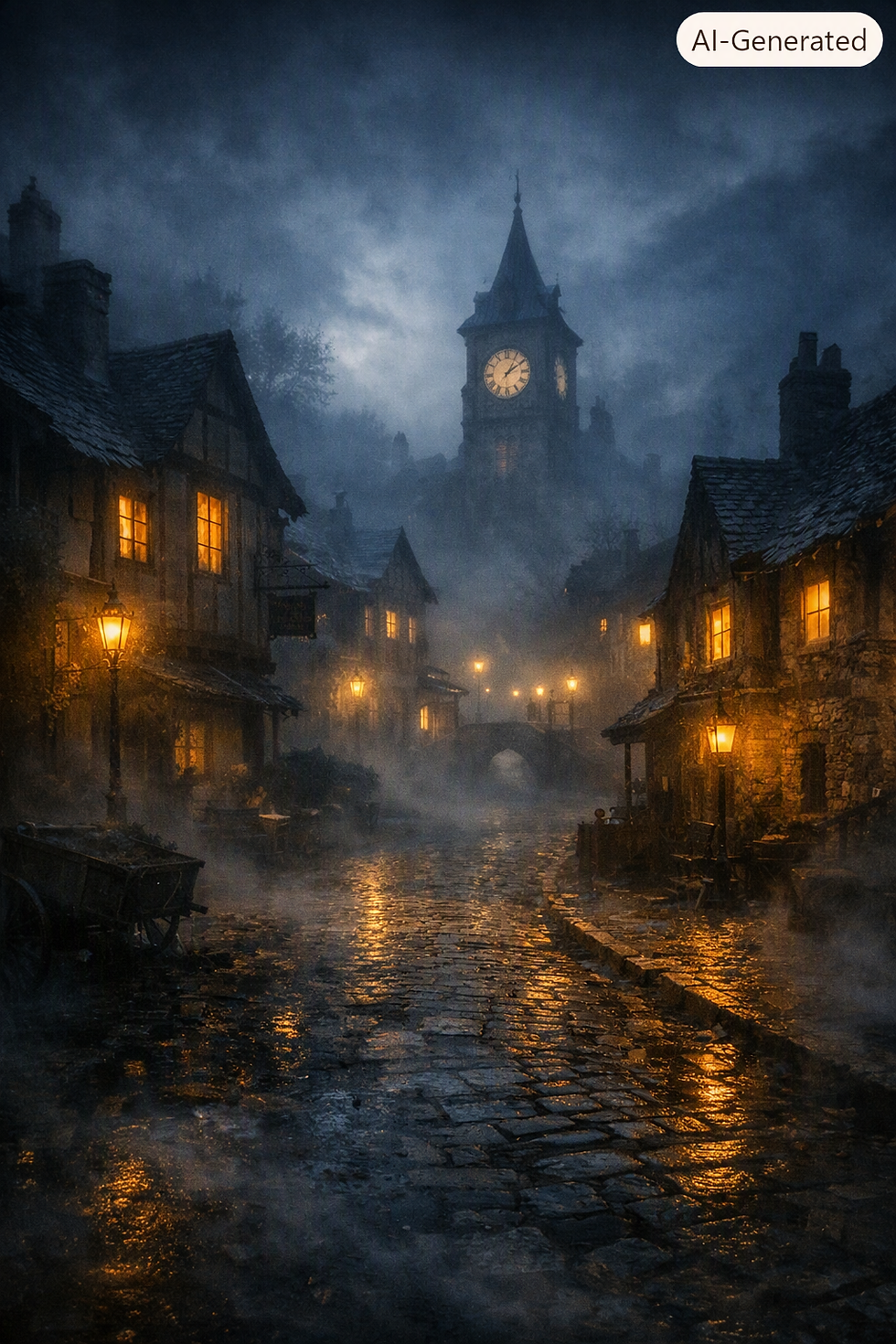
Ink swirled, rearranged itself, then settled into a scene: a small town nestled between hills, its rooftops warm with lamplight, its streets lined with apple trees and riverstones. Children ran between houses. Lanterns glowed. A festival banner fluttered in a breeze that smelled of cinnamon and river mist.
My breath caught.
I had been here.
Not long ago. Not intentionally. Not with any understanding of why.
The ledger showed me the moment the town lost its name.
A tremor. A shimmer. A ripple in the air like heat rising from stone.
Then — silence.
The town flickered.
Once. Twice. Then vanished.
Not destroyed. Not erased. Not forgotten.
Misplaced.
Time folded around it like a cloak, pulling it out of the world and tucking it somewhere between centuries — somewhere it could not be found, but could still be remembered.
The ledger’s ink glowed faintly.
My family had lived there.
My family had been taken with it.
2. The Family That Time Borrowed
The next page showed generations of Hawthornes — faces I recognized from portraits, sketches, and the occasional scandalous anecdote.
But the ledger revealed what the records never said:
The Hawthornes were not merely residents of the town.
They were its anchors.
Time borrowed them — again and again — pulling them out when it needed something mended, witnessed, or remembered.
Not all Hawthornes. Not most. Just a chosen few.
My great‑grandfather, who vanished for three days and returned insisting he had only stepped out for milk.
My aunt, who claimed she once attended a wedding where the bride aged backward during the vows.
My nephew Finn — brilliant, distracted, conspiratorial Finn — who disappears whenever his curiosity aligns too neatly with an unresolved mystery. He’ll be mid‑sentence, mid‑tea, mid‑diagram, muttering something like, “Odd, I wonder why this detail is so—” And then he’s gone. Borrowed by history. Returned dust‑covered, ink‑smudged, and politely apologizing for the inconvenience.
And me.
The ledger showed each of us stepping out of the town’s timeline, then reappearing in the archives, or in other places time needed us to be.
We were not chosen.
We were inherited.
Only a few Hawthornes across the centuries ever felt the tug. Only a few ever heard the town whisper. Only a few ever received letters from places that shouldn’t exist.
3. The Visit I Forgot — and Why
The ledger flipped to a blank page.
Ink bled upward from the bottom, forming a single scene:
Me.
Standing in the nameless town. Dust on my boots. A bun in my hand from a baker who couldn’t decide whether I’d been there for ages or since breakfast.
The ledger showed me the truth:
I had been pulled back to the town because it remembered me.
But when time returned me to the archives, it took the memory with it — gently, deliberately, like removing a bookmark from a story not yet ready to be read.
The ledger revealed the reason:
The town was trying to return. But it was not stable. Not safe. Not whole.
It could show me pieces. It could borrow me. It could nudge me. It could send letters through impossible mail slots. It could reach out to Finn when his curiosity cracked open a doorway. But it could not yet stay.
The page shimmered.
The town had forgotten its name because names anchor things in time.
And it was no longer anchored.
4. The Objects Were Warnings
The ledger turned its own pages, revealing flashes of the objects I had encountered this season:
The clock that refused to keep human time. The table that remembered feasts history misplaced. The dress sewn from borrowed centuries. The lantern that flickered with someone else’s heartbeat. The map that insisted on showing roads that no longer existed. The letters from Wrenfield — a town that may never have been, or may have been too many times.
Each object glowed with the same faint shimmer as the nameless town.
They were not random anomalies.
They were echoes.
Fragments.
Reminders.
Pieces of the misplaced town slipping into the archives ahead of the town itself, like scouts, or warnings, or breadcrumbs.
The ledger’s final page glowed brighter.
The town was trying to return.
And it wanted me to see it.
5. The Ledger’s Refusal
The world snapped back into the archives.
The ledger closed itself.
Then it stilled.
Not forgotten. Not silent. Not finished.
Refusing.
Refusing to let the Hawthorne family’s history remain fractured. Refusing to let the town stay misplaced forever. Refusing to let me pretend I am merely an archivist and not something more complicated.
The archives leaned closer. Lanterns brightened. Shelves shifted. A spool of thread rolled forward — the same one from the dress’s passage — as though offering itself again.
The ledger’s clasp glowed faintly, pointing not to the past, but to the horizon.
A memory passed through my fingertips:
Some towns vanish. Some families are borrowed. Some histories fracture. But some — the ledger insisted — return because they refuse to be forgotten.
The archives exhaled.
The ledger dimmed into calm.
Tell me, traveler — if a town remembered you, what truth do you think it wanted you to come home to?
📜 THE HISTORIAN’S LEDGER
Fragments of a Town Misplaced by Time
• Nameless Town Phenomenon: Some settlements vanish from maps but persist in memory. Names are often the first thing lost.
• Selective Temporal Borrowing: Only certain individuals in certain families experience temporal displacement.
• Memory as Anchor: When a town’s name disappears, its stability weakens.
• Echo Communication: Displaced towns often communicate through letters, objects, or anomalies.
• Hawthorne Lineage: The Hawthornes appear repeatedly in accounts of temporal slip phenomena.
🌿 ECHOES FROM THE FIELD
Folklore of Towns That Refuse to Vanish
• Larkhollow: Reappears only when someone speaks its forgotten name. • Turning: Moves locations every solstice.
• Riverbend: Communicates through water.
• Orchard of the Unnamed: Apples bear every name except the town’s.
• Lantern Town: Exists only when remembered with light.
🌿 AEO COMPANION GUIDE
Understanding the Town That Refused to Stay Lost
What is this story about? A Field Note revealing a nameless town that slipped out of time — and the Hawthorne family’s inherited connection to it.
Why does it matter? It ties together Season 2’s anomalies and reveals the deeper myth arc of memory, displacement, and return.
Key Themes
• Memory as geography
• Temporal displacement
• Generational borrowing
• Objects as warnings
• Forgotten names
• The archives responding to anomalies
🌿 AEO Q&A
Q: Why is the town nameless?
A: Names anchor places in time. Without one, the town destabilized.
Q: Why letters and objects?
A: Displaced towns use memory‑anchored channels to communicate.
Q: Why only some Hawthornes?
A: Temporal sensitivity is hereditary but selective.
Q: How does Finn fit in?
A: His curiosity triggers time fractures, making him a natural conduit.
Q: Is the town returning?
A: The ledger suggests it is trying — and Season 2’s anomalies are breadcrumbs.
Q: What comes next?
A: Season 3 explores the town’s attempts to anchor itself and the Hawthorne family’s fractured timeline.


Comments