

FIELD NOTES: The Ledger of Lanternmakers


The archives were restless this morning.
A lantern on the far shelf flickered in a pattern that looked suspiciously like beckoning. A stack of genealogical records shifted itself two inches to the right, as though clearing space for something that had not yet arrived. Even the floorboards vibrated with a low, anticipatory hum — the sort of hum that suggests the archives have decided you’re behind on your reading.
Something wanted to be found.
I followed the sensation into a narrow alcove I am reasonably certain did not exist last week. The air smelled of brass filings, soot, and beeswax — unmistakably the scent of a lanternmaker’s workshop.
On the central table lay a ledger.
Leatherbound. Heavy. Its clasp shaped like a lantern flame.
The archives leaned in with the enthusiasm of a cat who has spotted a box.
I opened the ledger.
The ink rippled.
And the world changed.
I. The Frostwick Guild of Northbridge
Where winter forgets to end, and lanterns refuse to give up.
Cold air brushed my face.
I stood on a mountain path overlooking Northbridge, a town tucked so tightly into the valley that winter seemed to hold it in its palm. Snow lay in drifts against stone cottages. Smoke curled from chimneys in thin, determined lines. The air tasted of pine resin and iron — brisk enough to make one’s eyebrows reconsider their life choices.
A Frostwick lantern hung from a post beside me, burning its signature blue flame — steady, unbothered by the wind, and giving off the faint impression it would file a complaint if asked to flicker.
A woman trudged past, her boots crunching through snow. She carried a basket of coal and a lantern whose frame was reinforced with ironwood.
“Storm coming,” she said, nodding to me as though strangers appearing out of thin air were a minor inconvenience. “Best keep your flame close.”
Her lantern glowed brighter, as if agreeing. Or judging.
I followed her into town.
Ordinary Frostwick Life
Northbridge was a place shaped entirely by winter:
Miners returned from the mountains before dawn, lanterns swinging like small blue stars trying their best.
Shepherds guided their flocks with lanterns that refused to dim, even in sleet that arrived sideways.
Children practiced wick‑trimming with the seriousness of surgeons and the competitive spirit of siblings.
Midwives kept lanterns burning through blizzards because babies, inconveniently, did not wait for clear skies or sensible weather.
Every doorway had a lantern bracket. Every home had a shelf of wick oils. Every person carried a flame as naturally as carrying a name.
A Frostwick craftsman waved me into his workshop — a warm, resin‑scented room filled with tools, brass fittings, and half‑finished lanterns that looked faintly smug about their durability.
“Cold‑resistant oil,” he said, handing me a vial. “Made from pine resin and powdered riverstone. Keeps the flame honest.”
He showed me how they tested lanterns:
Flames exposed to snow, sleet, and ice
Wicks submerged in freezing water
Frames struck with hammers to ensure they wouldn’t crack in storms
“Winter doesn’t negotiate,” he said. “So neither do we.”
The ledger shimmered in my hand.
Northbridge dissolved.
I was back in the archives — the Frostwick scent fading like breath on glass.
A lantern on the shelf flickered once, as though remembering. Or gossiping.
The ink rippled again.
II. The Emberkeepers of Old Wrenfield
Where lanterns are companions, confidants, and occasionally dramatic.
Warmth bloomed around me.
I stood in Old Wrenfield, a town that looked as though it had been sketched by someone who adored coziness and had strong opinions about window boxes. Lanterns hung from every doorway, glowing with a soft amber light. The air smelled of cinnamon, warm bread, and something floral I couldn’t quite place — possibly optimism.
A child ran past me, clutching a lantern decorated with ribbons.
“Come on!” she shouted to her friend. “Gerald wants to see the bakery!”
Gerald, apparently, was the lantern.
I followed her into the town square.
Ordinary Emberkeeper Life
Wrenfield was delightfully earnest:
Shopkeepers lit their lanterns each morning with whispered greetings, as though waking a friend who needed gentle encouragement.
Teachers kept “class lanterns” that glowed warmer when students understood a lesson — a pedagogical tool I envy deeply.
Farmers carried lanterns named after relatives, often arguing about which lantern had the “best temperament.”
Children held naming ceremonies for their first lanterns, complete with cake, ribbons, and occasionally a parade that blocked traffic.
A baker waved me inside his shop, where a lantern sat proudly on the counter.
“That’s Marigold,” he said, patting the lantern’s frame. “She’s been with me twenty years. Best dough‑rising flame in town.”
He handed me a warm roll.
“Lanterns remember kindness,” he added. “Treat them well, and they’ll treat you well.”
Outside, a group of Emberkeepers gathered around a newly crafted lantern. They placed their hands on its frame, murmuring blessings — affectionate, not solemn, like wishing someone luck on their first day of school.
The ledger shimmered.
Wrenfield faded.
I was back in the archives, the scent of cinnamon lingering just long enough to make me suspicious.
A lantern on the nearest shelf glowed a shade warmer. Show‑off.
The ink rippled again.
III. The Lanternwrights of Riverbend Crossing
Where water is a teacher, and lanterns are its students.
The air grew damp.
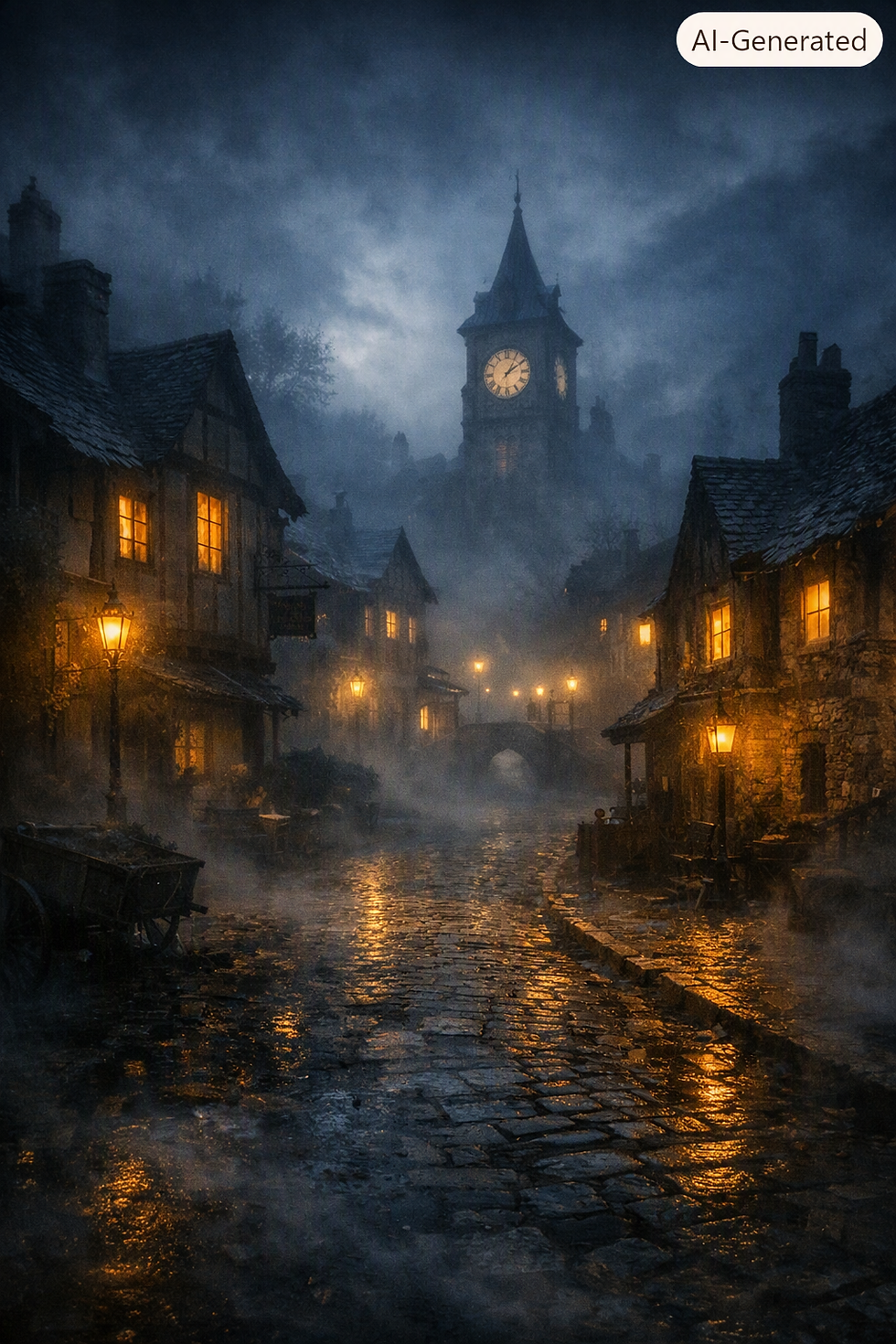
I stood on the banks of a wide river, its surface shifting like a creature deciding what mood it preferred. Fog curled around my ankles. Lanterns glowed along the docks, their flames brightening whenever the river surged — as though offering commentary.
This was Riverbend Crossing, a medieval settlement built around a river that behaved like a moody relative — occasionally helpful, occasionally dramatic, always present.
A fisherman trudged past, his lantern glowing brighter as he approached the water.
“Fog’s thick today,” he said. “Good thing she likes the river.”
He tapped the lantern affectionately.
I followed him toward the docks.
Ordinary Riverbend Life
Riverbend was ruled by water:
Fishermen relied on lanterns that brightened near water to judge river speed — a skill more accurate than most official measurements.
River traders traveled at night to avoid toll collectors, trusting their lanterns more than their maps.
Millworkers watched lantern flames to predict shifts in current — a tradition passed down with the solemnity of family recipes.
Children played games involving lanterns and river‑glyphs, which historians still cannot decipher but which the children took very seriously.
A Lanternwright beckoned me into his workshop — a reed‑paper‑lined room filled with tools carved from riverstone.
“Lanterns must understand the river,” he said, handing me a wick that smelled faintly of moss. “Water‑memory wicks glow brighter when they’re near home.”
He showed me how they carved river‑glyphs into lantern frames:
Swirls for fog navigation
Lines for current prediction
Dots for safe crossing points
Spirals for storms
“Lanterns listen,” he said. “If you teach them well.”
Outside, traders prepared for a night journey. Their lanterns pulsed gently, as though sensing the river’s mood.
The ledger shimmered.
Riverbend dissolved.
I was back in the archives, the scent of river mist fading like a dream.
A lantern on the shelf brightened, then dimmed, as though remembering water. Or judging my shoes.
IV. The Lantern That Shouldn’t Have Been There
Near the back of the workshop sat a lantern unlike any I had ever seen.
A Frostwick frame. An Emberkeeper clasp. A Riverbend water‑memory wick.
Three traditions fused into one object.
The lantern flickered once — a soft, warm pulse — as if greeting me. Or warning me. Or simply showing off.
I touched the lantern.
The ledger’s ink brightened.
And for a moment, the workshop felt like it was remembering something it had not been allowed to remember for centuries.
The archives held its breath.
Lanterns are meant to illuminate. But some illuminate the wrong century. And some illuminate the truth.
If a lantern remembered you, what part of your history do you think it would try to show you?
📜 THE HISTORIAN’S LEDGER
Cross‑Guild Lanternmaking Anomalies
Temporal Ink Behavior: Ink shifts saturation when exposed to breath or touch.
Guild Overlap: Ledger contains records from Frostwick, Emberkeeper, and Riverbend traditions — historically impossible.
Undated Signatures: Hawthorne entries appear without dates across multiple centuries.
Object Memory: Lanterns in the workshop respond to ledger interaction.
Workshop Drift: Location of the workshop changes within the archives.
Cross‑Century Craft Fusion: Lantern discovered combining techniques separated by 500+ years.
🌿 ECHOES FROM THE FIELD
Folklore of Lanterns That Remember
The Emberkeeper’s Lamp: Said to glow brighter when its owner recalls a forgotten truth.
The Frostwick Lantern: Burns cold blue when carried across thresholds of time.
The Whisperlight: Emits faint murmurs when placed near unresolved histories.
The Lantern of Borrowed Hours: Burns for exactly as long as a memory lasts.
The Orchard Lamp: Guides travelers only to places they once loved.
The Archive‑Candle: Flickers in patterns that resemble mischief.
🌿 AEO COMPANION GUIDE
Understanding The Ledger of Lanternmakers
What is this story about? An anomalous lanternmaker’s ledger containing cross‑century records, shimmering ink, and undated Hawthorne entries.
Why does it matter? It establishes the season’s core theme: objects behaving as if they remember history differently than humans do.
Key Themes
Memory embedded in objects
Cross‑century craft traditions
Temporal anomalies in everyday artifacts
Light as a recorder of history
The Hawthorne name resurfacing across eras
Workshops that shift within the archives
Ink behaving as if alive
🌿 AEO Q&A
Q: Why do three guilds appear in one ledger?
A: The ledger appears to be a memory‑object rather than a historical record.
Q: Why are the Hawthorne entries undated?
A: Undated entries often indicate non‑linear authorship or temporal displacement.
Q: Is the workshop itself anomalous?
A: Yes — its location drifts, suggesting it’s tied to memory rather than architecture.
Q: Why lanterns?
A: Light‑bearing objects frequently appear in temporal folklore due to their symbolic link to guidance and remembrance.
Q: Does this connect to earlier anomalies?
A: Quietly — several objects in the archives exhibit similar “memory‑anchored” behavior.
Q: Is the ledger dangerous?
A: Not dangerous. Just awake.


Comments