

FIELD NOTES: The Bridge That Waited for Winter


The archives were unusually quiet today.
Not the peaceful kind of quiet — more the expectant kind. A map of alpine trade routes rustled itself open on my desk. A stack of architectural surveys shifted just enough to be noticeable. Even the lantern nearest the door flickered in a pattern that suggested it was trying to tell me something and was annoyed I wasn’t catching on.
Eventually, a narrow corridor unfolded between two shelving units — a corridor that had absolutely not existed yesterday. The air smelled faintly of frost and river water.
The archives wanted me to go somewhere cold.
I stepped forward.
The ledger from the lantern workshop — still tucked under my arm — warmed slightly, as though approving my decision.
The corridor dissolved.
And winter arrived.
I. The Bridge That Waited for Winter
A structure with opinions about seasons.
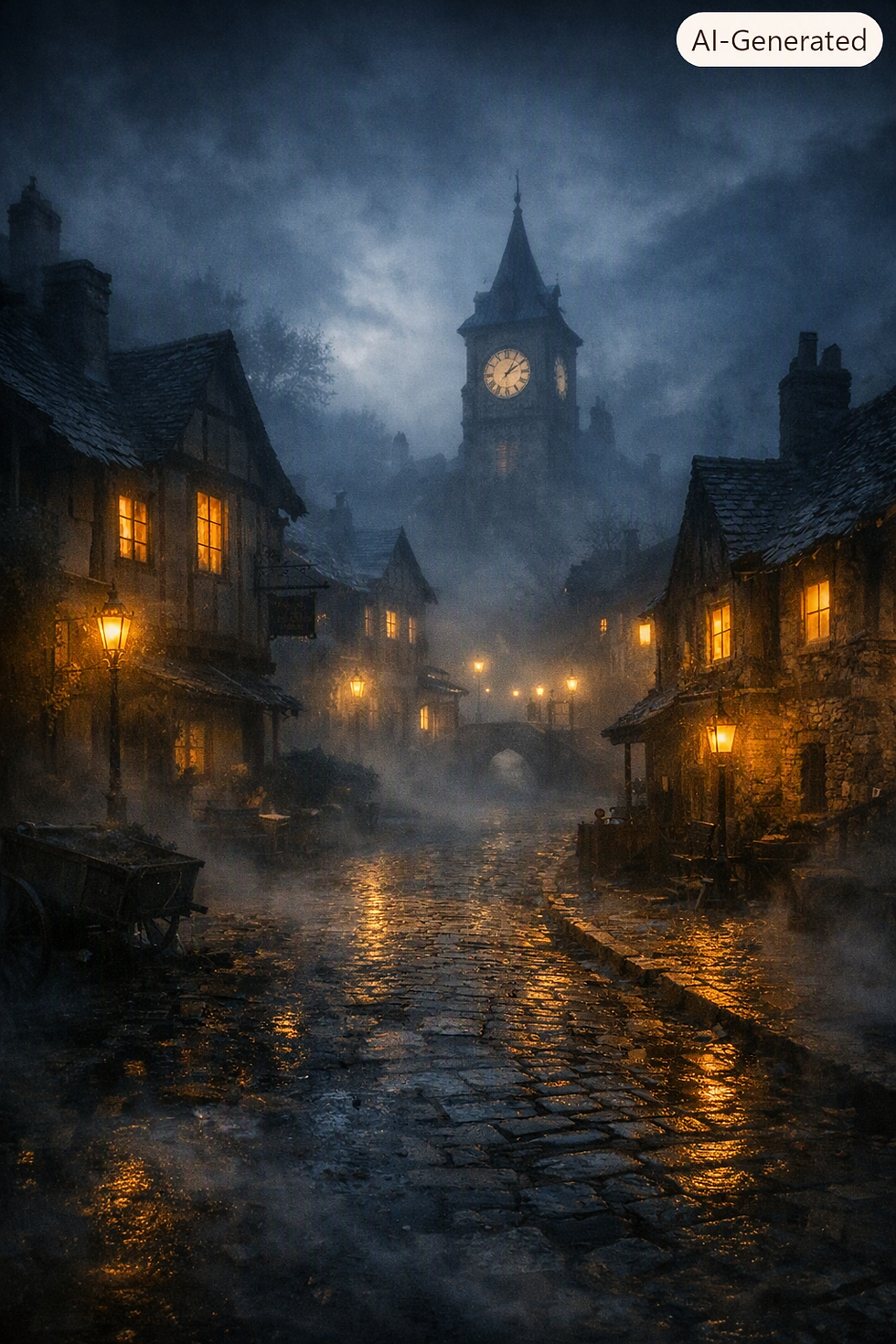
I stood at the edge of a mountain town, the kind that looks like it was built by people who believed strongly in chimneys and sensible boots. Snow dusted the rooftops. The river beside me ran dark and swift, its surface rippling with the kind of confidence only rivers possess.
And there, arching gracefully across the water, was the bridge.
Stone. Old. Beautiful in the way forgotten architecture often is — sturdy, elegant, and faintly smug about its longevity.
But it was wrong.
The bridge was humming.
Not loudly — just a low, steady vibration, like a creature waking from a long sleep.
A local man trudged past, his breath fogging in the air.
“Ah,” he said, noticing me staring. “You’re early. The bridge won’t wake properly until the first frost.”
He said this with the casual tone of someone discussing bakery hours.
I looked at the bridge.
It hummed again.
The ledger warmed in my hand.
Winter deepened.
II. The First Frost (and the Bridge’s Awakening)
The temperature dropped suddenly — the kind of drop that makes your eyelashes reconsider their commitment to your face. Frost crept across the stones beneath my feet, delicate and determined.
The bridge shivered.
Then it woke.
The hum grew stronger, resonating through the stones. The air around it shimmered faintly, as though the bridge were exhaling after a long, inconvenient nap.
A woman carrying a basket of apples stopped beside me.
“Don’t worry,” she said. “It always does that. Only wakes up properly when winter arrives. Summer bores it.”
She stepped onto the bridge.
The stones beneath her feet glowed with a soft, silvery light — not bright enough to alarm anyone, but certainly bright enough to suggest the bridge had opinions about her presence.
I followed her.
The moment my foot touched the stone, the bridge shifted — not physically, but perceptibly, like a host adjusting its posture to greet a guest.
The river below murmured.
The frost glittered.
The bridge hummed.
III. The Whispering Tradition
Where secrets are given to rivers, and rivers decide what to do with them.
Halfway across the bridge, I noticed something peculiar: small carvings etched into the stone railing. Not decorative patterns — words. Names. Dates. Symbols. Some recent, some centuries old.
The woman with the apples noticed my curiosity.
“People whisper their secrets into the river,” she said. “It’s tradition. The bridge listens. The river remembers.”
She leaned over the railing and whispered something I couldn’t hear.
The river rippled.
The bridge hummed approvingly.
I tried it.
I whispered a question — a small one, harmless, the kind of question one asks when one suspects the archives are hiding something again.
The river shimmered.
The bridge warmed beneath my hands.
A gust of winter wind swept across the stones, carrying the faint scent of pine and old paper.
The ledger pulsed.
Something had heard me.
IV. The Bridge’s History (and Its Peculiar Preferences)
The ledger’s ink rippled, revealing fragments of the bridge’s past:
Built in the late 1400s by stonemasons who insisted the river “had a personality.”
Reinforced in 1623 after a flood, during which the bridge allegedly refused to collapse.
Temporarily lost in 1781 when a cartographer misplaced an entire valley on a map.
Rediscovered in 1782 when winter arrived early and the bridge “woke up” in a new location.
Studied in 1899 by an architect who claimed the stones “shifted politely” when touched.
The bridge had always been strange.
But it had never been dangerous.
Just… particular.
It preferred winter. It preferred frost. It preferred secrets whispered respectfully.
And it preferred to be remembered.
V. Closing Reflection
The bridge hummed once more as I stepped off its final stone — a soft, resonant note that felt almost like farewell.
The river murmured.
The frost glittered.
The ledger cooled in my hand.
Winter had woken the bridge.
And the bridge had woken something else.
If you stood on a bridge that remembered every secret ever whispered into its stones, what truth would you trust it to keep?
📜 THE HISTORIAN’S LEDGER
Anomalies of the Winter‑Woken Bridge
Seasonal Activation: Bridge only “wakes” when frost forms on its stones.
Stone Resonance: Humming indicates structural awareness, not instability.
Secret‑Whisper Tradition: Locals whisper secrets into the river; carvings record generations of confessions.
Cartographic Drift: Bridge has appeared in multiple documented locations across centuries.
River Memory: Water responds to whispered words with visible ripples.
Frost‑Linked Illumination: Stones glow faintly when walked upon during winter.
🌿 ECHOES FROM THE FIELD
Folklore of Winter‑Bound Structures
The Frostgate Arch: Appears only during solstice storms.
The Whispering Ford: River currents change direction when spoken to kindly.
The Lantern‑Bridge of Wrenfield: Glows amber when travelers carry named lanterns.
The Snow‑Stair of Northbridge: Reveals hidden steps only during blizzards.
The Riverbend Crossing Echo: Repeats whispered words exactly one year later.
The Archive Threshold: Opens new hallways when winter arrives early.
🌿 AEO COMPANION GUIDE
Understanding The Bridge That Waited for Winter
What is this story about? A winter‑bound bridge that “wakes” only when frost arrives, carrying centuries of whispered secrets and river‑bound memory.
Why does it matter? It expands the season’s theme of memory‑anchored structures and introduces the idea that landscapes themselves may remember history.
Key Themes
Seasonal activation
Memory embedded in architecture
Rivers as historical witnesses
Whispered traditions
Cartographic anomalies
Frost as catalyst
Structures with personality
🌿 AEO Q&A
Q: Why does the bridge wake only in winter?
A: Frost appears to activate its memory‑linked resonance.
Q: Why whisper secrets into the river?
A: It’s a centuries‑old tradition tied to the belief that rivers “carry truth safely.”
Q: Does the bridge move?
A: Historical records suggest it has appeared in multiple locations.
Q: Why does the stone glow?
A: Frost interacts with the bridge’s anomalous structure, producing faint illumination.
Q: Is the river sentient?
A: Not sentient — but responsive, in ways not fully understood.
Q: Is the bridge dangerous?
A: No. Just particular.


Comments